The AI Job Search Toolkit: Live Demo
Taking the tool live for 52 job seekers, and using the room to test a harder claim: AI value isn’t just the CV it writes, it’s the time it gives back.
Workshop Facilitation

The problem — Teaching complexity in real time
In April 2026, I built The AI Job Search Toolkit for myself, to help me cut the time to apply to jobs with a tailored CV. I then uploaded this toolkit to a hub and shared it in my network, including the career coach I was working with at the time. She immediately could see how useful this tool was and invited me to present it to other clients of the coaching firm, Mäder & Partner.
The real challenge with this demo is that my Toolkit isn’t a simple click-and-go tool. It requires users to do some work: define a job search strategy, build a Master CV, and set a tone of voice for their cover letter – all this before the AI workflow even starts. The actual design problem was to explain that upfront investment live without losing the audience.
The design decisions — Authentic, but not left to chance
01 — Live demo
A pre-recorded walkthrough would have been safer and easier to control. I chose the live demo because it mirrors the toolkit’s philosophy: human-in-the-loop and visible thinking. If the point of the toolkit is that the AI asks you questions before acting, the demo had to show that happening in real time.
02 — One golden path, not the full workflow
The toolkit runs five workflows across three entry tools (Prompts; Custom GPTs; Claude Skills). Trying to present all of it in a 30-minute slot would have felt rushed. I scoped the demo to the first three steps, using Claude Skills. This was enough to show the mechanism without diluting it.
03 — Pre-staged segments inside a live format
Fully live, unscripted answers to AI questions risked creating lulls during the demo (the moments where I’d otherwise have to improvise an answer that kept the demo moving). I pre-prepared certain segments so that the flow would move at a good pace, ensuring the audience would be able to follow, while keeping the core mechanism alive.
04 — Using my personal profile
I chose to use my own personal profile, as opposed to creating a synthetic persona. I used my own Claude account, my own CVs and a job ad that matched my profile. It’s also the argument that the toolkit makes: an AI is only as sharp as the context you feed it. I wasn’t going to demonstrate that principle with a fake profile.
What happened — Smooth delivery, sharp questions
The demo ran inside a 50 mins session, with 30 minutes for my presentation, and the rest reserved for introductions and Q&A. The scoped, pre-staged approach meant the live segments ran smoothly enough that the audience could follow.
During the Q&A, two questions stood out:
“Could the tool help with finding job listings, not just applying to them?” – I answered honestly: I had built a near-agentic workflow on Claude Cowork but killed it because it didn’t outperform simply using LinkedIn or Indeed’s job alert functionality. The workflow kept stalling on individual company career portals. Claude could not crawl them reliably, which defeated the whole point of catching listings early.
“What’s the success rate of AI applications?” – I answered that this wasn’t the right question to ask or expectation to have. AI is not a magic bullet for getting hired. What it does is take over the mechanical, repetitive work (updating a CV, drafting a cover letter) that compounds over a months-long search. The value is in the time that it frees up for candidates. Time that they can spend networking and becoming the kind of candidate a company wants to hire. This answer specifically resonated with the Mäder & Partner team.
Results — Engagement in the room, momentum after it
52 people attended the session (one of the best attended sessions of the outplacement firm's workshops)
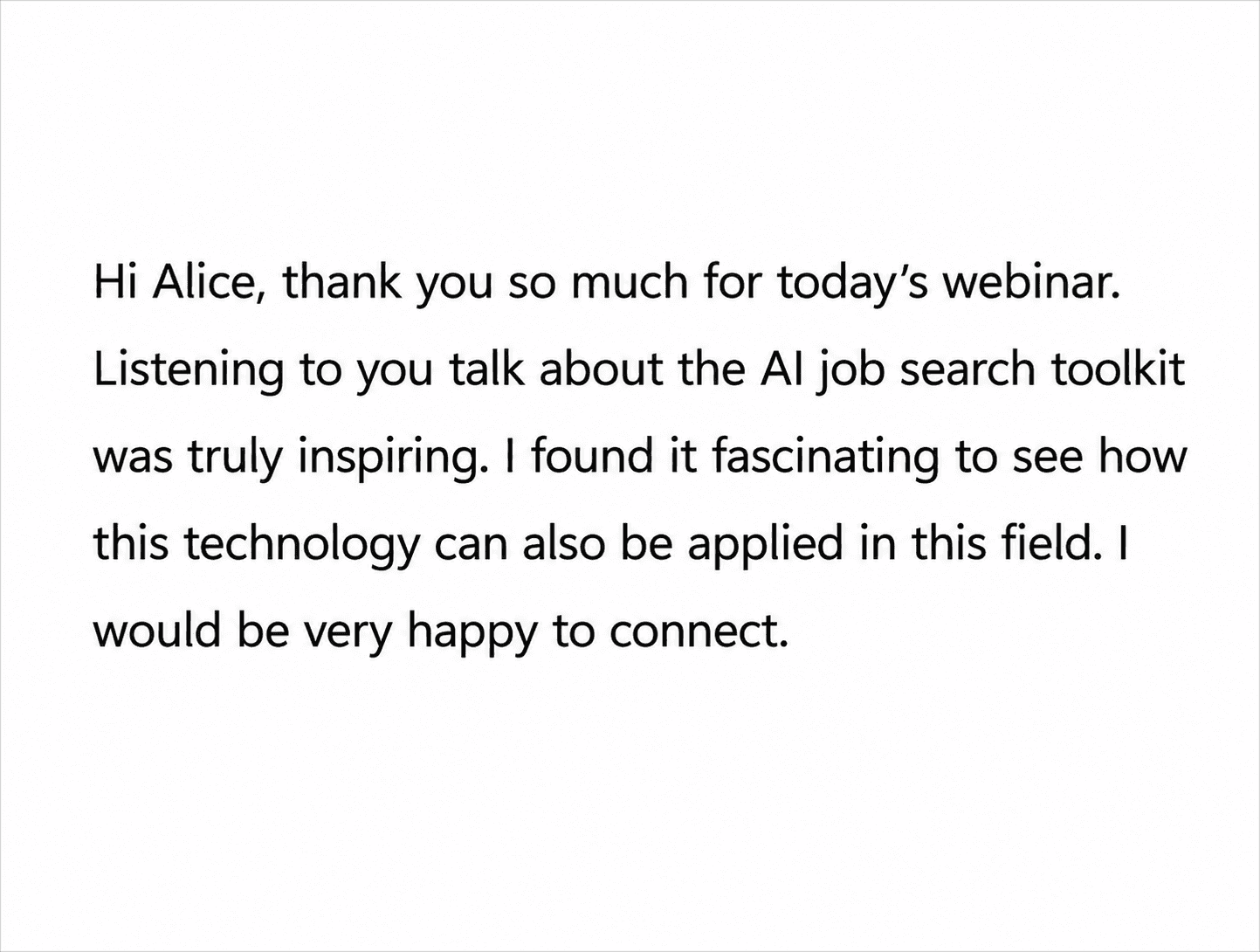
16 LinkedIn connection requests received following the session, with unsolicited positive feedback
1 glowing written feedback from Mäder & Partner, including the suggestion that I should “sell” the toolkit.
The bigger insight
"The best answer to “Does AI work?” is to redefine the value that AI brings. It’s not just the applications AI writes for you, it’s the hours it gives back for you to do the things that only you can do."
What I'd do differently — More time, harder questions
I would have loved two things:
A longer session, with more time to highlight the parts of the workflow that showed how my tool is different from what is currently available online, namely the questions I embedded into the workflow.
A discussion about the ethics of using AI for job search on recruiter and candidate side. With Mäder & Partner team members among the audience members, this was the perfect set-up to have this all-important conversation.